


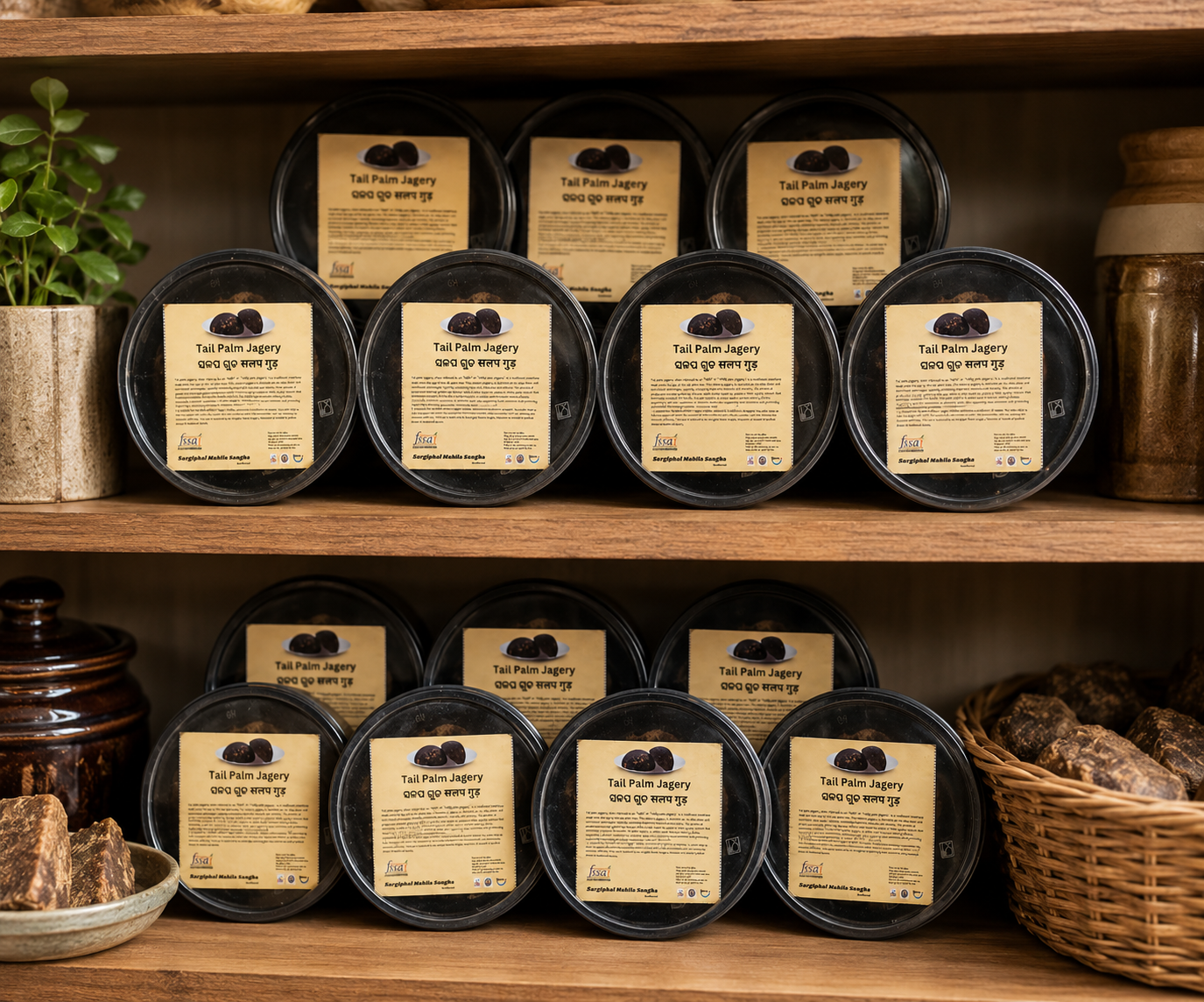
SALAPA GUDA - Traditional Tail Palm / Fishtail Palm Jaggery from Odisha
Local name: Salapa Guda / ସଲପ ଗୁଡ଼
Botanical source: Caryota urens L.
Common English name: Fishtail Palm / Jaggery Palm
Region associated with this product: Kandhamal and other forested and rural regions of Odisha. Producer shown on the product pack: Sargiphal Mahila Sangha, Kandhamal
Salapa Guda is a traditional jaggery made by concentrating the sap of the native Salapa palm. Unlike ordinary sugarcane jaggery or Khajuri Guda, it comes from a completely different botanical source — the Fishtail Palm, Caryota urens L.
The Odisha State Botanical Garden identifies Salapa as Caryota urens L., a member of the palm family Arecaceae, found in forested and rural areas of Odisha. Its sap is traditionally used to make jaggery.
-----------------------------------------------------------------------------------
1. WHAT IS SALAPA GUDA?
Salapa Guda is a traditional palm jaggery prepared from the sweet sap of the Salapa palm.
The tree is botanically known as Caryota urens L. and is commonly called the Fishtail Palm because of the distinctive fishtail-shaped leaflets of its leaves.
The product is therefore fundamentally different from:
- Sugarcane jaggery — made from sugarcane juice
- Date Palm Jaggery / Khajuri Guda — made from the sap of Phoenix species, particularly date palm
- Coconut palm jaggery — made from coconut palm sap
Salapa Guda belongs to the traditional family of palm-derived non-refined sweeteners.
The Odisha State Botanical Garden specifically records Salapa's sap as a source for jaggery.
-----------------------------------------------------------------------------------
2. Salapa is not simply a modern alternative sweetener.
It is associated with indigenous and rural food systems of Odisha.
Government documentation on indigenous knowledge records Caryota urens / Salapa among traditional plant resources used by communities including Dangaria Kandha and Lanjia Saora. Traditional sap collection is specifically documented.
Research into indigenous plant use in Odisha also records Salapa and traditional use of its juice.
The Salapa palm is therefore connected to:
- Forest landscapes
- Indigenous knowledge
- Traditional beverages
- Seasonal food practices
- Palm tapping
- Rural livelihoods
- Traditional sweeteners
- Community knowledge systems
INTACH's documentation of Saora cultural life also records Salpa (Caryota urens) among traditional food and beverage resources of the community.
A living heritage, The most important story is that Salapa is a living tradition, not merely an archaeological or historical food.
The same native palm continues to provide a raw material that can be converted into a modern packaged food product.
-----------------------------------------------------------------------------------
3. THE SALAPA PALM — THE TREE BEHIND THE PRODUCT
Botanical name: Caryota urens L.
Family: Arecaceae
Common name: Fishtail Palm
The palm gets its English name from its unusual leaflets, which resemble the tail of a fish.
The Odisha State Botanical Garden describes it as a tall palm with distinctive, deeply cut fishtail-shaped leaves and records its distribution in Odisha's forested and rural areas.
The tree has multiple traditional uses.
Its sap can be processed into sweeteners and can also be used traditionally as a beverage. Other parts of the palm have also been used in traditional food and material systems.
This makes Salapa particularly interesting from a biodiversity-linked livelihood perspective.
-----------------------------------------------------------------------------------
4. FROM TRADITIONAL SAP TO VALUE-ADDED FOOD
One of the most interesting aspects of Salapa is that the same palm resource can support different traditional uses.
Fresh sap can be consumed as a beverage and, if allowed to ferment, can become an alcoholic beverage.
Processing the sap into jaggery creates a different pathway:
Native Palm → Sap → Food Processing → Shelf-Stable Jaggery → Market Value
This has an important livelihood implication.
Instead of selling or consuming only the raw seasonal resource, communities can create a higher-value, longer-shelf-life product.
There are documented examples from Odisha where Salapa sap has been converted into jaggery as part of livelihood interventions for local communities.
For ODH, this is an important model of:
Traditional resource + local processing + women/community enterprise + modern market access.
-----------------------------------------------------------------------------------
5. HISTORY, GEOGRAPHY & CULTURAL HERITAGE
Salapa is not simply a modern alternative sweetener. It is associated with indigenous and rural food systems of Odisha.
Government documentation on indigenous knowledge records Caryota urens / Salapa among traditional plant resources used by communities including Dangaria Kandha and Lanjia Saora. Traditional sap collection is specifically documented.
Research into indigenous plant use in Odisha also records Salapa and traditional use of its juice.
The Salapa palm is therefore connected to:
- Forest landscapes
- Indigenous knowledge
- Traditional beverages
- Seasonal food practices
- Palm tapping
- Rural livelihoods
- Traditional sweeteners
- Community knowledge systems
INTACH's documentation of Saora cultural life also records Salpa (Caryota urens) among traditional food and beverage resources of the community.
A living heritage: The most important story is that Salapa is a living tradition, not merely an archaeological or historical food.
The same native palm continues to provide a raw material that can be converted into a modern packaged food product.
-----------------------------------------------------------------------------------
6. TASTE, COLOUR, TEXTURE & APPEARANCE
Salapa Guda has a sensory identity that is different from conventional sugarcane jaggery.
Taste, Expect:
- Deep sweetness
- Caramel-like notes
- Earthy undertones
- A distinctive palm character
- More complex flavour than refined sugar
Aroma : A traditional palm-jaggery aroma with warm, caramelised and earthy notes.
Colour : Depending on sap, processing and concentration, Salapa jaggery can range from: Golden-brown → amber → deep brown
Texture : Traditional palm jaggery may have :
- Dense texture
- Soft-to-firm consistency
- Slightly sticky character
- Natural variation between batches
This variation should not automatically be treated as a defect.
For a traditional product, batch-to-batch variation can be part of its authentic character, provided the product meets food-safety and quality requirements.
-----------------------------------------------------------------------------------
7. WHAT MAKES SALAPA GUDA DIFFERENT?
The biggest difference is the raw material.
Feature : Salapa Guda | Date Palm Jaggery / Khajuri Guda | Sugarcane Jaggery.
Source : Salapa/Fishtail Palm| Date palm sap | Sugarcane juice.
Botanical identity : Caryota urens | Phoenix species | Saccharum species.
Plant type : Palm | Palm| Grass/crop
Odisha association : Strong forest/tribal association | Strong traditional association in Odisha| Widely produced agricultural sweetener
Typical flavour : Deep, caramel-like, earthy | Rich, aromatic, fruity/caramel-like | Strong, familiar molasses-like sweetness.
Texture : Dense/soft-firm depending on processing| Often dense or soft | Firm, block/powder/liquid forms
Story : Native palm + indigenous knowledge | Traditional date-palm tapping | Traditional cane processing
Biodiversity narrative : Very strong| Strong| More agricultural than forest-linked
Rarity/differentiation : High Relatively common
The important point is that Salapa Guda should not compete with sugarcane jaggery purely on price.
It should compete on: origin + rarity + taste + heritage + producer story + biodiversity + authenticity.
FAQs
Everything you need to know before purchasing this product.